


In 1870 New Zealand’s agent-general in London, Isaac Featherston, toured Norway, Sweden and Denmark recruiting settlers for the colony. Prospective migrants were promised free passage and 10 acres of land. In 1871 the first government-assisted Scandinavian immigrants arrived in Wellington aboard the Celaeno. The 18 families settled on 40-acre sections between Palmerston (North) and Foxton, opening a road and tramway through the bush that gave settlers access to Palmerston.
Perceptions of New Zealand – ‘wild animals, snakes and English people’
Prospective migrants’ knowledge of New Zealand was very limited. To the average 1870s Scandinavian there was a degree of fascination with a country on the opposite side of the earth, ‘with the feet of its inhabitants pointing towards us’. Most knew of Māori, but there were shipboard rumours of ‘wild animals, snakes and English people’.
Letters home helped provide a more accurate view. But it was not always easy to convey what life was like here – as one Dane who visited his homeland found out. When he enthused about the wonders of the new land, its giant trees, flightless birds, prodigious grasses and the prowess of its sheep-shearers, his mother gravely informed him that his travels had turned him into a teller of tall tales.
The Seventy Mile Bush
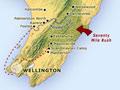
Known to Māori as Tapere-nui-a-Whātonga, this forest stretched for 70 miles from Wairarapa to Hawke’s Bay. A key aspect of Vogel’s immigration and public works plans was to establish Scandinavian settlements along road and rail lines surveyed though the bush.
In 1871, the New Zealand government sent Swedish settler Bror Erik Friberg to recruit immigrants in Norway and Sweden. Agents like Friberg offered a subsidised passage and 40 acres of land at £1 per acre, all of which could be paid off by working on road and rail construction. In May 1872 the ship Høvding left Christiania (Oslo) for Napier with 365 Norwegians and 11 Danes. Meanwhile the Ballarat (with 71 Danes aboard) set sail from London for Napier.
By 1872 the government-named towns of Norsewood and Dannevirke had been surveyed. Dannevirke’s plans show evocative street names such as Gertrude, Dagmar, Christian and Hamlet. But these roads existed only on paper and the young immigrant families arrived to an expanse of dense forest.
As farms were drawn by ballot, nationalities were mixed throughout the region, although there were concentrations of Norwegians in Norsewood and Danes in Dannevirke. Families often shared crude punga and tōtara bark houses while ‘slabs-hus’ (slab huts) were built. Men laboured on roads and railways, often living away from home to pay debts. Women and children remained in rough forest homes growing cabbages, potatoes and carrots among the tree stumps. Fever claimed seven lives by January 1873. When the 1880s depression hit, some unemployed men felt betrayed by a government that had promised them work.
Bushfires helped clear the felled forest but many houses, barns and fences also went up in smoke. In 1888 a massive bushfire razed Norsewood and threatened to do the same to Ormondville until a timely thunderstorm extinguished it. During the 1880s the Napier to Palmerston North railway made slow progress through the bush. Sawmilling began, and tree by tree the land was cleared to become productive farmland.
The Forty Mile Bush
The portion of the Seventy Mile Bush south of the Manawatū River was known as the Forty Mile Bush. In 1872 the first southern Wairarapa settlers arrived in Wellington on the England. The ship’s doctor was incompetent and an outbreak of measles had seen 14 Scandinavians buried at sea. Crossing the Remutaka Range proved a novel experience for plains-dwelling Danes. At Masterton the greens-starved settlers gathered watercress for their evening meal. Intrigued Māori picked up on the often heard ‘Ja, ja’ (yes, yes), dubbing them ‘Yaya’.
After crossing the Ruamāhanga River the Scandinavians encountered thousand-year-old trees looming up from a thicket of ferns, shrubs and supplejack – a far cry from the open silver birch and fir forests of their homelands. Crude huts were built at what was labelled ‘the Scandinavian Camp’. Towns were planned at Mauriceville and Eketāhuna (Mellemskov – ‘between woods’ in Danish).
By the end of 1873 most were settled on their 40-acre plots. With living costs high, they supplemented sugar and flour with the forest’s bounty – eels, honey, pigs, cattle and ‘vild-duen’ (wood pigeons).
During the early years of assisted migration (1871–76) there were 3,327 arrivals. In 1878 Scandinavians made up just over 1% of the New Zealand population – the highest proportion they were ever to reach.