



1920s–1930s: Norwegian whalers on Rakiura (Stewart Island)
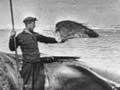
During the 1920s and 1930s, Norwegian whalers prowled the Southern Ocean. Summers were spent chasing leviathans in the Ross Sea. Over winter, ships headed north to Paterson Inlet on Rakiura (Stewart Island) to prepare for the next season. In 1927 machine shops, a huge workshop, boiler room, blacksmith’s forge and slipway were built at Prices Inlet. The Norwegian flag was soon flying from the manager’s house. The settlement was short-lived as the early 1930s were marked by a glut of whale oil and the economic depression. In 1933 the factory ship Sir James Clark Ross returned to Norway with its whale chasers in convoy. Today Prices Inlet is littered with rusting propellers, boilers and concrete foundations – the legacy of a short-lived enterprise. Some whalers married local women, but most returned to Norway with their ships.
1950s–1960s: Danish assisted migration
A shortage of labour in the 1950s prompted the government to offer travel subsidies of £50 (equivalent to $3,000–$4,000 in the 2020s) to unmarried Danish builders aged 20–45. In 1955 this inducement was extended to include free passage from England for all unmarried Danes aged 18–45. The only requirements were ‘good health and good character’. Between 1956 and 1967, 234 single men and 26 single women received some immigration assistance. Between 1945 and 1968, 2,151 Danes arrived – the largest influx of Scandinavians since the organised immigration of the 1870s.
Finns
Fewer than 2,000 Finns have migrated to New Zealand. Early arrivals were mariners who formed scattered coastal settlements. The main Finnish inflow was in the 1950s and 1960s when the growing pulp and paper industry imported Finnish technology. Groups of Finns and their families were recruited by New Zealand Forest Products. Most went to Tokoroa and Kawerau, where they found conditions bleak but quickly adapted. A sauna was built and sports and cultural activities were organised by the Finnish club. Some chain migration of friends and relatives followed. By the 1970s second-generation Finns had been assimilated, and the Finnish club closed in 1984. In 2013 more than one-third of Finns lived in Auckland, which had an active Finnish society.
A prize of war
In the Second World War, Finland was a ‘territory in enemy occupation’. All Finnish ships within Allied waters were fair game. In 1941 the sublime deep-sea square-rigger Pamir was seized in Wellington as a ‘prize of war’. The crew were detained, but allowed to work ashore.
From 1942 to 1948 the Pamir sailed across the Pacific. On its tenth voyage it circumnavigated the globe. Many young Kiwis gained their sea legs on the Pamir.
In November 1948 the Pamir was returned to Finland. Its former commander, Captain Björkfelt, flew out to sail it back. The Pamir capsized in a hurricane in the Atlantic in 1957, with the loss of all but six of the 86 men on board.
1970s–2000s: recent migration
In the 1970s immigration slowed with New Zealand’s economy. During the 1990s, as the economy improved, some 1,000 Scandinavians were approved as permanent residents. Swedes have been the most numerous recent immigrants, followed by Danes, Norwegians and Finns. Most are professionals who have arrived through work or marriage.
There are at least a dozen Scandinavian organisations. Clubs based on nationality often speak the native tongue, as members are more recent immigrants. Although members of societies in Norsewood and Dannevirke trace their ancestry to early settlers, they are now totally assimilated. And even if ‘farvel’ signs and folk dancing have made recent appearances, very little Scandinavian culture is evident. In 2003, Tararua district councillors implemented the wishes of Dannevirke residents by voting against a proposal for a 10-m-tall Viking statue.