

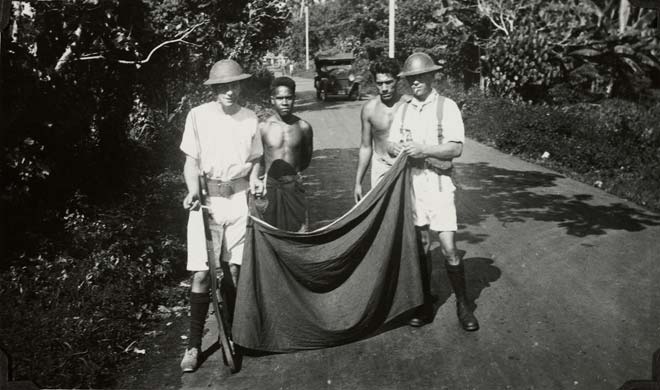
Two New Zealand sailors remove the Mau insignia, a white band, from the lavalavas of two Samoan men in 1930. The Mau independence movement had precedents in small-scale protests against German colonial authority in 1904–5 and 1909, and was linked to disquiet amongst chiefs about the reshaping of the traditional order. Under New Zealand rule, the Fono of Faipule (a council of faipule, or district representatives, which acted as a bridge between districts and the government) acquired greater authority than it had had under German rule. Customary chiefs feared that this would eclipse their status. White traders also resented New Zealand rule, as the authorities tried to force up the prices paid for Samoan produce. Traders backed a 1921 petition asking that Samoa be controlled by Britain.
Te whakamahi i tēnei tūemi
Alexander Turnbull Library, F. J. Gleeson Collection
Reference: PA1-0-795-17-4
Permission of the Alexander Turnbull Library, National Library of New Zealand, Te Puna Mātauranga o Aotearoa, must be obtained before any re-use of this image.