

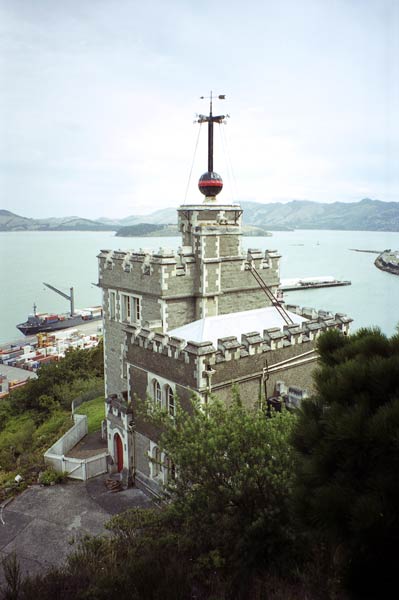
Exact time was very important for ships, as it allowed them to check their chronometers and determine longitude. In 1829 the first timeball came into use at Portsmouth in England. Visible to ships in the port, the ball would be dropped at a regular time every day. It became a common feature of ports around the world. The Timeball Station at the port of Lyttelton, near Christchurch, was built in 1876. It had an astronomical clock from Edward Dent & Co., who made the mechanism for London’s Big Ben. The timeball mechanism was 15 metres high, and the ball, which weighed over 100 kilograms, was dropped every day at 1 p.m. By 1918, when exact time was increasingly supplied by radio, the ball was dropped only twice weekly at 3.30 p.m. In 1934 the service ceased. The Timeball Station was damaged in the September 2010 earthquake, and further damaged beyond repair in the February 2011 earthquake. A partial reconstruction of the was completed in 2018.
Te whakamahi i tēnei tūemi
Heritage New Zealand – Pouhere Taonga
Permission of Heritage New Zealand Pouhere Taonga must be obtained before any re-use of this image.