

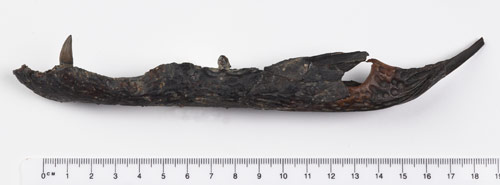
In Near Oceania, Lapita people found abundant food sources including marsupials, reptiles, birds, wild plants and fish. Small bands of people lived in relative ease in this region for tens of thousands of years. Lapita middens reveal that they ate land birds in the Ha‘apai group of Tonga, and in New Caledonia and Fiji, a terrestrial crocodile (Volia athollandersoni). Fossil remains of the crocodile are shown here. Birds on these islands were quickly consumed and some species became extinct. On the islands of Remote Oceania edible seeds, tubers and fruit were scarce. Lapita groups carried domestic animals and horticultural crops with them as they colonised new islands.
Using this item
Palaeofaunal Surveys
by Mike Neill and T. H. Worthy
This item has been provided for private study purposes (such as school projects, family and local history research) and any published reproduction (print or electronic) may infringe copyright law. It is the responsibility of the user of any material to obtain clearance from the copyright holder.